Is Root Canal Treatment Painful?
Root canal treatment is usually done with local anaesthetic numbing the tooth, which is how pain is controlled while the inside of the tooth is being treated. Afterwards, mild soreness or tenderness can occur for a few days and should gradually improve. If pain is severe, keeps getting worse or does not settle, the tooth needs to be checked again.
So the honest answer is that the treatment itself is not meant to hurt and the days after can feel tender. Some of the pain people link with root canals comes from the inflamed or infected pulp itself, which can hurt before any treatment starts.
Why do root canals have such a painful reputation?
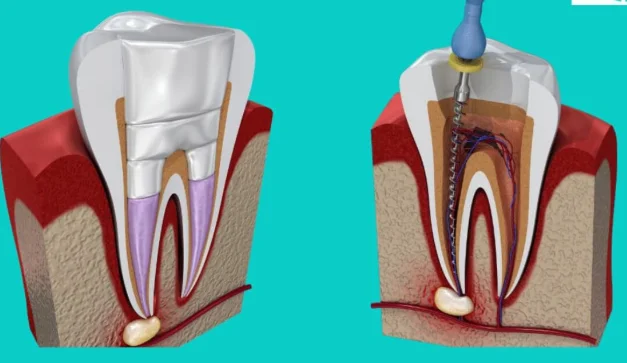
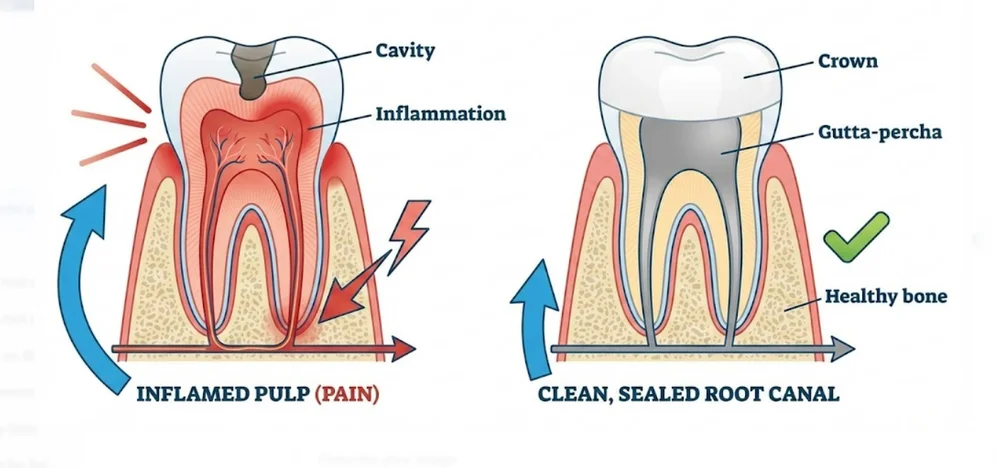
Inside every tooth is soft tissue called the pulp. Deep decay can let bacteria reach and infect it, and a crack, an injury or repeated dental work on the same tooth can also damage it (American Association of Endodontists). When the pulp is inflamed or infected, it can cause pain when you bite, sensitivity to hot or cold that lingers, or swollen gums.
That toothache is something an inflamed or infected pulp can cause on its own, before any treatment starts. Left untreated, an infected pulp can keep causing pain or lead to an abscess, which is a pocket of infection. Root canal treatment removes the diseased pulp, then cleans, shapes, fills and seals the canals inside the root so that a restorable tooth can be kept (AAE: Root Canal Explained).
What will I feel during the treatment?
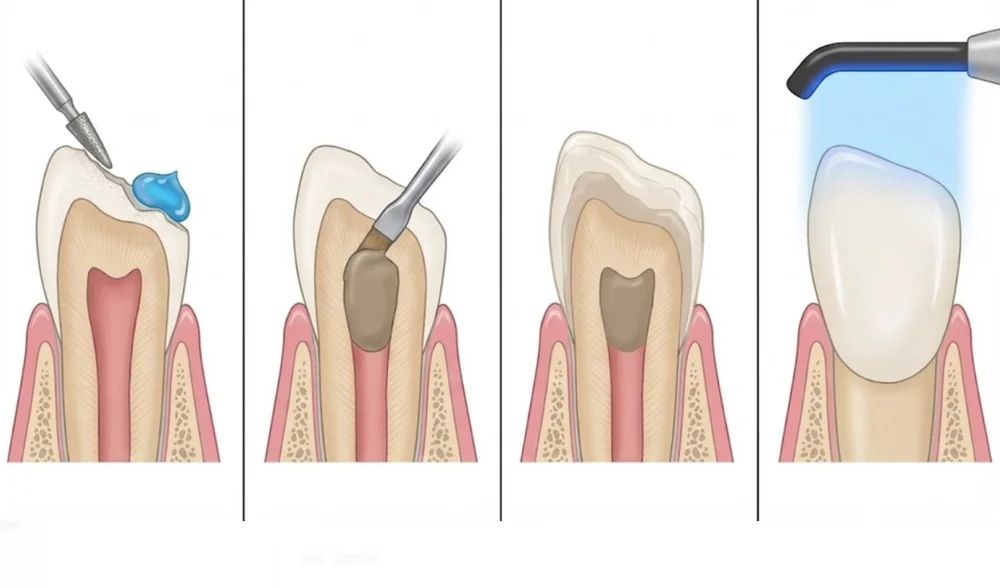
Before anything else, the dentist examines the tooth and takes an X-ray. Then:
- Numbing: local anaesthetic is usually used to numb the tooth before treatment starts.
- Keeping the tooth clean and dry: a thin protective sheet called a dental dam is placed around the tooth to keep saliva away from it.
- Cleaning the canals: the canals are prepared with a combination of hand instruments, powered instruments and cleaning solutions.
- Filling and sealing: the cleaned canals are commonly filled with a rubber-like material called gutta-percha together with a sealer.
Anaesthetic is used to control pain, but nobody can promise that every person will feel nothing at all. If you feel pain during the appointment, tell your dentist straight away so they can stop and reassess. You do not have to sit through it quietly.
Will it take more than one visit?
It depends on the tooth. Some root canals are completed in a single appointment; others are spread over two or more visits, with a temporary filling placed in between (NHS: Root canal treatment). A temporary filling is not the final restoration, and even when the canal work is finished in one visit, the final filling or crown may need another appointment. The number of visits on its own does not tell you how comfortable a treatment will be.
How painful is it afterwards?
Two separate questions are hiding here: how often people feel sore, and how bad it is.
How often: soreness after treatment can happen. It is not something every patient should expect.
How bad: when it does happen, the expected kind is mild soreness or tenderness that lasts a few days and gets better, not worse. There is no fixed deadline that fits every tooth, but the direction matters. Improving day by day is reassuring; worsening or long-lasting pain is a reason to call.
To help the tooth settle:
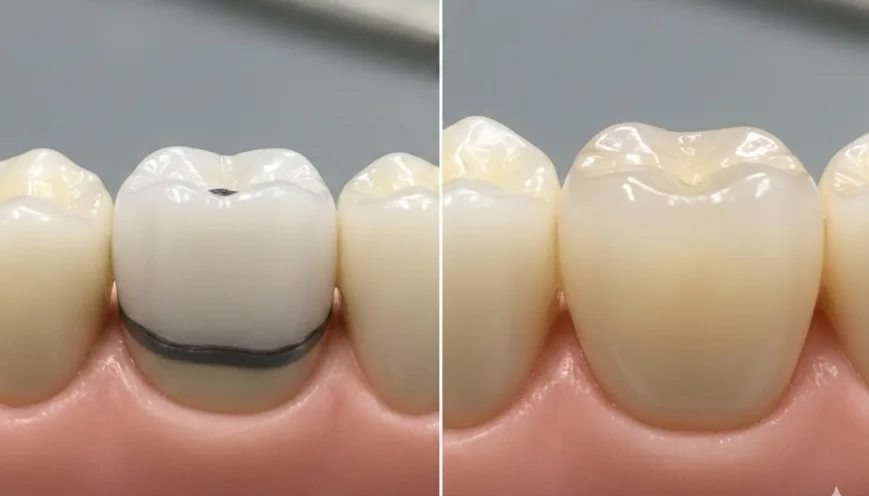
- Avoid chewing hard on it until the final filling or crown is in place. A root-treated tooth that has not yet been fully restored is more likely to break under biting pressure.
- Keep brushing and cleaning around it while following the instructions your dental team gives you.
- Ask which pain relief suits you. The right choice depends on your health and any medicines you already take, so check with the team rather than guessing.
- Go back for your follow-up visits and keep up your regular check-ups, on the schedule your dentist advises.
When should I contact my dentist after a root canal?
Contact the clinic that treated you if:
- the pain is severe, getting worse, or still there when you expected it to have settled
- swelling appears, or you notice signs that suggest an abscess, such as swollen gums near the tooth
A suspected dental abscess needs urgent dental care, because it does not reliably clear up without treatment (NHS: Dental abscess). This is different from the mild, improving soreness described above.
When is it a medical emergency?
Some signs mean a dental infection may be spreading. Go to a hospital emergency department straight away, rather than waiting for a dental appointment, if a tooth problem comes with any of these:
- difficulty breathing, speaking or swallowing
- major swelling in the mouth
- swelling or pain around the eye, or sudden changes in your vision
- difficulty opening your mouth
These are warning signs of infection, not ordinary soreness after treatment (NHS: Dental abscess).
Does toothache always mean I need a root canal?
No. A root canal may be considered when the pulp is inflamed or infected and the tooth can be restored, but tooth pain or a crack on its own does not prove that you need one. That is why the examination and X-ray come first. Sometimes the answer is a simpler treatment; our article on filling or root canal for a deep cavity explains what decides it.
Sometimes a tooth cannot be saved at all. A badly fractured root, too little bone support, or too little tooth left to rebuild can mean the tooth cannot be kept, and taking it out becomes the alternative.
Can a root-treated tooth hurt again later?
A fully developed adult tooth can keep working without its living pulp, because the tissues around the root continue to nourish it. It still needs a proper final restoration, a filling or a crown depending on how much healthy tooth remains.
Root canal treatment does not always succeed. A treated tooth may not heal as expected or may develop new problems later. Further treatment, such as repeating the root canal or, in selected cases, endodontic surgery, can sometimes still save it; extraction is an alternative, not an automatic outcome (AAE: Endodontic Retreatment Explained). Pain that returns or never fully settles should be checked rather than ignored.
Worried about a painful tooth in Solapur?
If fear of the treatment is what is holding you back, it helps to talk it through before anything is done. At Deshpande Dental in Solapur, root canal treatment is led by Dr. Rucha Deshpande, a conservative dentist and endodontist (a dentist who focuses on treating the inside of the tooth). You can read more about root canal treatment at our Solapur clinics, or book a check-up and ask every question you have before you decide.