Dental Implants vs. Bridges: What's the Best Choice for Missing Teeth?
10 December, 2025Implants vs Bridges
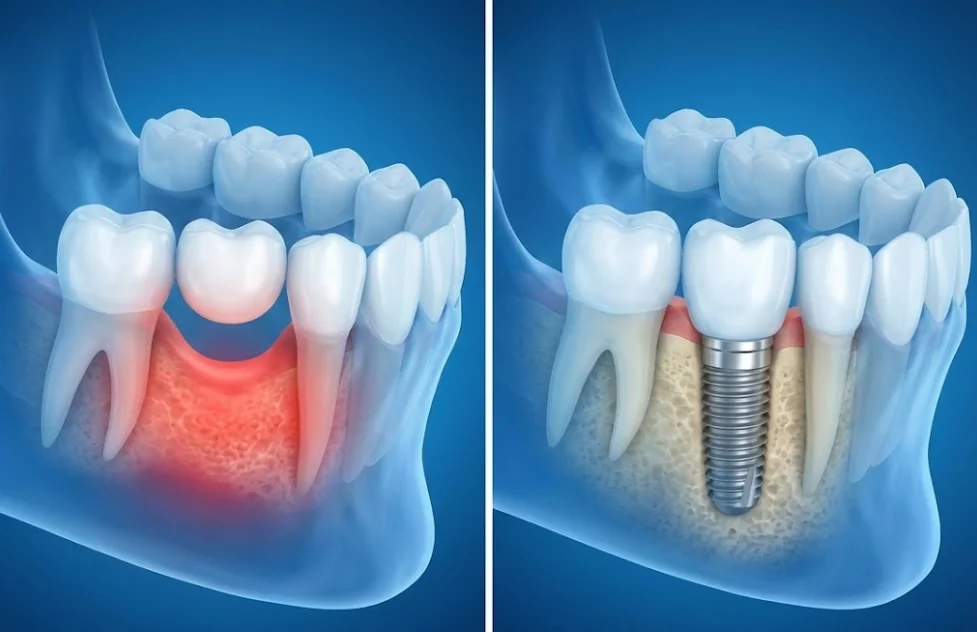
Diagram comparing bone loss under a dental bridge versus bone preservation with a dental implant

When you lose a tooth, the clock starts ticking. It's not just about the gap in your smile; it's about what happens beneath the surface. Your jawbone begins to shrink, your surrounding teeth start to shift, and your chewing efficiency drops.

At Deshpande Dental Care & Implant Centre, we see patients every day in Solapur who are torn between the two most common solutions: Dental Bridges and Dental Implants.

While both options fill the gap, they work in fundamentally different ways. This guide will help you understand the medical, financial, and practical differences so you can choose the best option for your health.

1. The Dental Bridge: The "Quick Fix"

For decades, the dental bridge was the standard of care. As the name suggests, it bridges the gap created by a missing tooth. It consists of a false tooth (pontic) fused between two dental crowns.

How It Works

To place a bridge, the dentist must file down the healthy natural teeth on either side of the gap. These teeth act as "anchors" to support the bridge.

The Advantages

  • Speed: The entire process is non-surgical and typically takes just 2 visits over 7-10 days.
  • Familiarity: It feels similar to having crowns placed.
  • Cost: The upfront cost is generally lower than an implant.

The Hidden Downsides

  • Damage to Healthy Teeth: This is the biggest drawback. You are essentially turning two healthy teeth into "traumatized" teeth by removing their enamel. If one of these anchor teeth fails later, the entire bridge fails.
  • Bone Loss: A bridge sits on top of the gums. It does not replace the tooth root. Without stimulation from a root, the jawbone underneath the gap will shrink (resorb) over time, potentially causing a "sunken face" look.

2. The Dental Implant: The "Artificial Root"

A dental implant is the modern gold standard. It doesn't just replace the visible white part of the tooth; it replaces the root as well.

How It Works

A small, medical-grade titanium screw is surgically placed into your jawbone. Over a period of 3 to 4 months, your bone grows around this screw (a process called osseointegration), locking it in place. Once healed, a custom crown is fixed on top.

The Advantages

  • Bone Preservation: This is the only tooth replacement option that stimulates the jawbone, preventing bone loss and facial aging.
  • Zero Damage to Neighbors: We do not touch the adjacent teeth. They remain 100% intact.
  • Longevity: While bridges often need replacement every 10-12 years due to leaks or decay, a well-maintained implant can last a lifetime.

The Considerations

  • Time: The process is longer (3-6 months) to allow for biology to take its course.
  • Surgery: It requires a minor surgical procedure (though it is usually painless under local anesthesia).

The Cost Perspective: Short Term vs. Long Term

Many patients in Solapur choose bridges because they appear cheaper initially. However, economists often call bridges "the more expensive option" in the long run.

  • Scenario A (Bridge): You pay for a bridge now. In 10 years, the gum recedes, or a cavity forms under one of the anchor caps. You now have to pay for a new bridge, and potentially a root canal for the damaged anchor tooth.
  • Scenario B (Implant): You pay a higher initial fee. The implant integrates and stays stable for 25+ years. You have paid once for a permanent solution.

Dr. Varun's Expert Verdict

As a Prosthodontist, Dr. Varun Deshpande specializes in complex rehabilitation. Here is his rule of thumb:

"I strictly advise against cutting down healthy teeth. If your adjacent teeth are virgin (no fillings, no decay), a Dental Implant is the only logical choice.

However, if the teeth next to the gap are already heavily filled or previously root-canal treated, a Dental Bridge can be a smart way to crown those weak teeth and fill the gap simultaneously."

Comparison Summary

FeatureDental BridgeDental Implant
Structure3 Crowns fused togetherStandalone titanium post + Crown
Neighbor TeethMust be filed down (Irreversible)Untouched (Conservative)
Bone HealthBone continues to shrinkPrevents bone loss
Lifespan10-15 Years25 Years to Lifetime
CleaningDifficult (needs special floss)Easy (brush and floss normally)

Conclusion

Don't just fill the gap—restore your health. If you are eligible for an implant, it is the closest thing to getting your natural tooth back.

Still unsure? Visit Deshpande Dental Care & Implant Centre (Civil Chowk or Jule Solapur). We will take a 3D CBCT Scan to check your bone density and give you an honest recommendation.
Frequently Asked Questions


The main difference is how they interact with your mouth. A bridge uses adjacent healthy teeth as anchors (requiring them to be filed down) and sits on top of the gums. An implant is a standalone titanium screw placed into the jawbone, replacing the tooth root without damaging neighboring teeth.

Dental implants are superior for bone health. Because the implant acts as an artificial root, it stimulates the jawbone and prevents the bone shrinkage (resorption) that naturally occurs after tooth loss. Bridges do not stimulate the bone, which can lead to a 'sunken face' look over time.

Dr. Varun advises against cutting down healthy 'virgin' teeth to support a bridge. He recommends implants because they are a conservative solution that leaves adjacent teeth 100% intact. He generally reserves bridges for cases where the neighboring teeth are already damaged or heavily filled.

Initially, implants have a higher upfront cost than bridges. However, implants are often more cost-effective in the long run. While bridges may need replacement every 10-12 years due to decay or wear, a well-maintained implant can last 25 years or more, making it a one-time investment.

A bridge is the faster option, typically requiring just 2 visits over 7-10 days. An implant is a longer process, taking 3 to 6 months. This extra time is necessary for 'osseointegration,' where the titanium screw fuses securely with your jawbone.

Contrary to popular belief, placing an implant is a minor surgical procedure usually performed under local anesthesia. Most patients at Deshpande Dental Care report little to no pain during the procedure, and recovery is generally straightforward.

Dental bridges typically last between 10 to 15 years before needing replacement due to leaks or decay on the anchor teeth. Dental implants are designed to be a permanent solution and can last a lifetime with proper oral hygiene.

Yes, bridges can be slightly harder to clean than implants. Because the bridge is fused together, you cannot floss between the teeth normally; you need special floss threaders to clean underneath it. Implants are cleaned exactly like natural teeth with regular brushing and flossing.

A bridge might be a better choice if the teeth next to the gap are already weak, heavily filled, or have had root canals. In this specific scenario, a bridge reinforces those weak teeth with crowns while simultaneously filling the gap.

You can visit Deshpande Dental Care & Implant Centre at their Civil Chowk or Jule Solapur branches. They use advanced 3D CBCT scanning to check your bone density and help you decide between a bridge and an implant.

Still have questions?

Can't find the answer you're looking for? Please chat with our friendly team.

Contact Us Today

More Blogs

Clinical comparison of a patient with severe tooth wear before and after Full Mouth Rehabilitation.
10 December, 2025

Do I Need Full Mouth Rehabilitation? 5 Signs Your Bite is Collapsing

Are your teeth looking short or worn down? You might be suffering from 'Bite Collapse.' Learn the 5 warning signs and how Full Mouth Rehabilitation by Dr. Varun Deshpande can restore your face and function

Read Blog
porcelain veneers on front teeth
10 December, 2025

Porcelain vs. Composite Veneers: Which Smile Makeover Fits Your Budget?

Dreaming of a perfect smile but unsure about the cost? We compare the price, durability, and aesthetics of Porcelain vs. Composite Veneers to help you choose the right option in Solapur

Read Blog
Diagram showing inflamed dental pulp causing pain versus a clean, sealed root canal
10 December, 2025

Is Root Canal Treatment Painful? Myths vs. Modern Reality

Dreading a root canal? Discover why the "pain" is a myth. Learn how modern anesthesia and rotary technology make RCTs at Deshpande Dental Care painless and fast

Read Blog
Step-by-step diagram of dental composite layering technique on a fractured incisor
10 December, 2025

What Happens During an Aesthetic Restoration? A Step-by-Step Guide

Curious how we fix chipped teeth or close gaps in just one hour? Dr. Rucha Deshpande walks you through the 5 steps of Aesthetic Composite Restoration

Read Blog
Side-by-side comparison of a metal-ceramic crown showing a dark line versus a translucent zirconia crown
10 December, 2025

Zirconia vs. Metal Crowns: Why Metal-Free Caps Last Longer

Choosing a dental cap? We compare old-school Metal (PFM) crowns with modern Zirconia. Discover why Zirconia is stronger, safer, and looks 100% natural

Read Blog
Teeth Whitening
10 December, 2025

Professional Whitening vs. Home Kits: Which is Safer for Your Enamel?

Thinking of buying charcoal powder or a whitening toothpaste? Read why professional whitening at the dentist is safer, faster, and more effective for your enamel

Read Blog
Complete and Partial Dentures
10 December, 2025

Tired of Loose Teeth? How Complete and Partial Dentures Restore Chewing and Confidence

Struggling with loose dentures or missing teeth? Discover how modern BPS Complete Dentures and Cast Partials offer superior suction, comfort, and chewing ability

Read Blog
Root Canal vs Filling
10 December, 2025

Deep Cavity Treatment: When Do You Need a Root Canal vs. a Filling?

Is it just a cavity or something worse? We explain the difference between reversible sensitivity and nerve infection, and how Dr. Rucha Deshpande saves teeth from Root Canals

Read Blog
TMJ Headache Treatment
10 December, 2025

Waking Up with Headaches? It Might be TMJ Disorder

Do you suffer from chronic morning headaches or migraines? The cause might be your jaw, not your head. Learn how TMJ Disorder causes pain and how Dr. Varun Deshpande treats it

Read Blog